


2026-03-02 15:03:21
|
 769
769
 0
0
Geopolitics in Flux, Haven Demand Surges
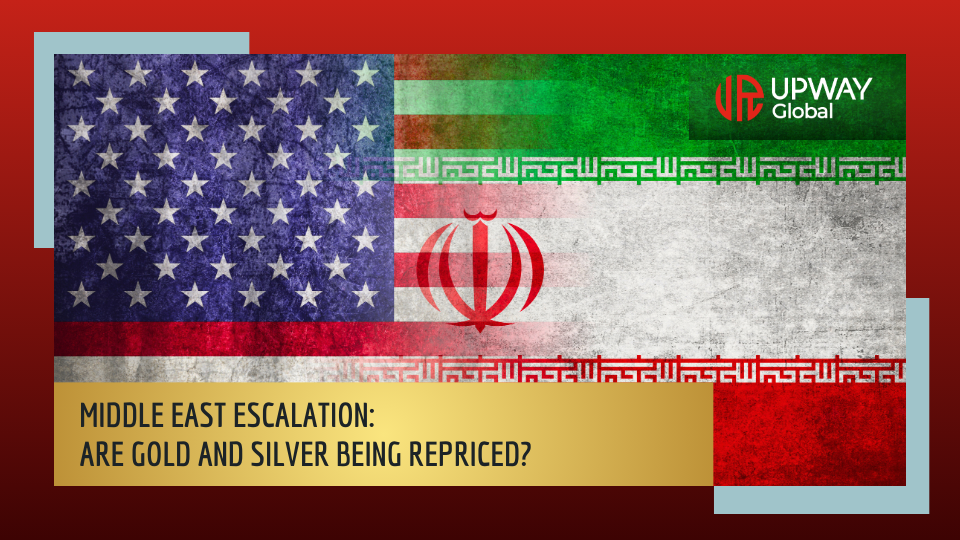
In recent days, tensions in the Middle East have escalated sharply as the United States and Israel carried out strikes against Iranian targets and Iran retaliated, putting maritime security—particularly in the Strait of Hormuz—back at the center of global risk discussions. Against this backdrop, haven demand has accelerated: gold pushed through key psychological levels and, on intraday spikes, challenged the $5,300–$5,460/oz area, while silver recorded 5%–8% single session gains on multiple occasions. This has revived market conversations about a possible $6,000 near term gold scenario should conflict intensify. Several banks have noted that, in an escalation case, gold could rally ~15% in the first couple of weeks to the $5,500–$5,800/oz range, though they also caution that purely geopolitical “war premium” gains can partially unwind once markets adapt to the new information set.
How Risk Premium Transmits Into Prices
The conflict is transmitting into precious metals pricing through three well known channels. First, direct safe haven rotation out of risk assets into gold. Second, the oil channel: elevated disruption risk to Persian Gulf shipments lifts crude prices, nudging inflation expectations higher and compressing real yields, which improves gold’s relative carry versus income bearing assets. Third, broader portfolio re balancing toward hard assets when equity and currency volatility rises, further supporting gold and silver bids. These mechanics have been on display around the late February strikes and subsequent weekend headlines, which coincided with fresh spikes in bullion and renewed talk of higher tactical price objectives.
ETF and Central Bank “Base Money” Still in the Market
Flows and positioning continue to underpin the medium term case. In January 2026, gold backed ETFs posted a record US$19bn net inflow, adding roughly 120 tonnes and lifting global gold ETF AUM to a fresh all time high of US$669bn. Notably, North America and Asia led the buying, and even on pullback days many funds added on dips, suggesting that investors increasingly treat gold as a core allocation rather than a tactical trade. On the official sector side, central bank net purchases in 2025 totaled about 863 tonnes, with Q4 alone at ~230 tonnes, still far above the 2010–2021 annual average of ~473 tonnes, reinforcing the reserve diversification and dedollarization narrative that has supported gold’s multi year uptrend.
Silver’s High Beta Profile: Elasticity With Risk
Compared with gold, silver has displayed greater upside elasticity during haven waves while also reflecting swings in industrial demand. Following the latest geopolitical flare up, international spot silver has reestablished itself in the $85–$90/oz area in several sessions, with Asia and India prints echoing the move. The episode also served as a reminder that silver’s volatility cuts both ways; managing exposure and drawdown matters more than directional conviction. Market commentary through late February pointed to $70–$75 as a dense support zone and $92–$96 as a tactical confirmation band for potential further upside toward $100–$105, contingent on conflict dynamics and inventories.
Gold as the “Core,” Silver as the “Satellite”
Given today’s pricing structure, gold should remain the core position in multiasset portfolios over the next one to two quarters, with staged buying on weakness around well defined supports. If geopolitical risk persists, gold retains its role as the portfolio ballast even before any higher targets are validated. Practically, many institutions now view $5,000/oz as a neutral pivot zone, while $4,500–$4,550/oz has emerged as a stronger technical support area for adding medium to long term exposure on corrective phases. Silver, by contrast, is best treated as a satellite allocation to enhance return asymmetry through tactical swings. Because silver’s volatility is structurally higher, position sizes should be smaller than gold and paired with firm stop loss discipline to avoid leverage driven forced selling during airpockets.
From a top down perspective, the current Middle East shock is one node in a broader global risk matrix that also includes the trajectory of U.S. tariff policy, global liquidity, real rate dynamics in core bond markets, and Asia led capital flows—all of which continue to shape precious metals benchmarks. While the near term war premium can retrace if diplomacy gains traction, the medium term structural case for gold and, selectively, for silver remains intact. In practice, emphasizing buy the dip in gold and tactically engaging silver—while maintaining rigorous exposure controls and cross asset hedges—offers a more robust institutional playbook for the current environment.
Upway Global: At the Forefront of Gold Trading and Market Excellence
As one of the elite members of the Hong Kong Gold Exchange (HKGX) with AA operation status (Membership No. 084) and a core member of the Bullion Group, Upway Global was awarded the prestigious "Authorised Good Delivery Bars Minter" certification—the highest standard in refining and delivery of physical gold bars, confirming its capability to produce gold bars that meet international purity and quality standards. This recognition signifies Upway Global’s commitment to upholding industry-leading professionalism and integrity while reinforcing Hong Kong’s position as Asia’s global gold trading hub.
Demonstrating robust market strength, Upway Global’s daily transaction volume recently surpassed USD 80 billion, setting a record and underscoring its role as a market leader. With over 2.1 million active traders and a cumulative order volume exceeding 700 million, Upway Global continues to foster a trading ecosystem characterised by transparency, security, and efficiency. The company’s average monthly trading volume in 2025 til now exceeded USD 681 billion, making it the top performer on the HKGX platform.
Risk Disclosure
This report is based on publicly available information and mainstream media coverage. Policies and data may change upon release of official documents or judicial rulings. Precious metal prices are affected by USD dynamics, interest rates, geopolitics, and central bank demand, among other factors, and are subject to significant volatility. Any investment views herein are for reference only and do not constitute investment or trading advice for any individual. Please assess decisions prudently in light of your own risk tolerance and financial conditions.





 简体中文
简体中文

 繁體中文
繁體中文


 TradingView
 MT5 Web
 Spot Gold/Spot Silver
 Accounts
 Wallet
 Promotions
 Trading Tools
 News Updates
 Economic Calendar
 Investment Academy
 Beginner’s Guide
 Anti-Fraud Guide
 FAQs
FAQs
 Upway APP
 Upway Desktop
 CTOTrader
 Upway HD
 MetaTrader 4
 About Upway
 Company News
 Affiliate Program
 Contact Us
