


2026-01-14 15:18:10
|
 16167
16167
 0
0
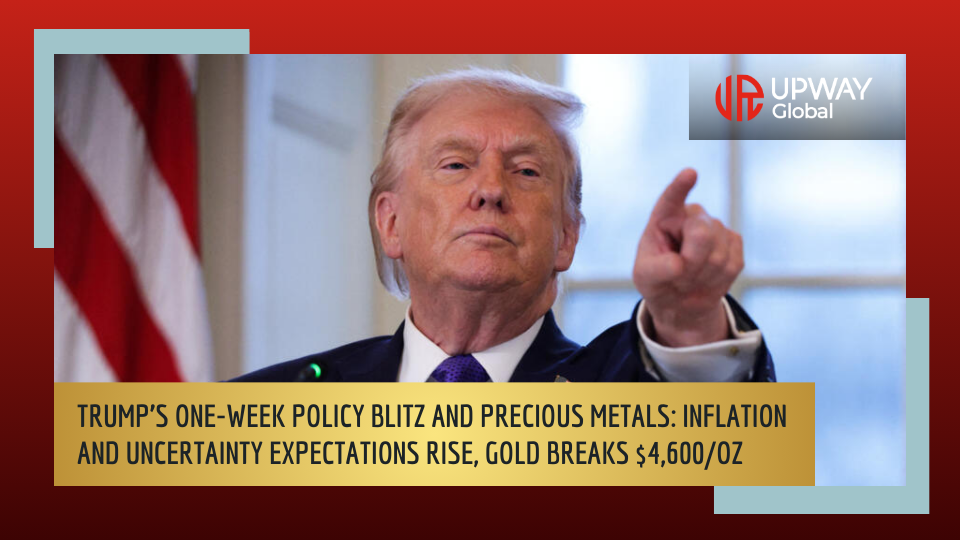
Over the past week, U.S. policy signals and geopolitical risks have intensified, driving a marked increase in global safe-haven demand. On January 12, spot gold printed an all-time high, intraday reaching roughly $4,629.94/oz and closing near $4,609.58, while silver also set a new record, peaking around $85.75/oz. Key drivers included unprecedented concern over Federal Reserve independence, escalating Iran-related risks, and a renewed rise in fiscal/credit easing expectations. Together, these factors enhanced the relative appeal of non yielding assets, pressured the U.S. dollar, and attracted concentrated allocations into precious metals.
I. Threatening a 25% Tariff on Countries Trading with Iran: Broad-Based Geopolitical Risk, Safe-Haven Demand Accelerates
On January 12, President Trump stated on social media that the U.S. would “immediately impose a 25% tariff on any country doing business with Iran,” calling the order “final and conclusive.” Although the White House has not yet published detailed documentation or the legal basis, mainstream media broadly noted the potential breadth of spillovers across Iran’s major trade partners (e.g., China, India, the UAE, Türkiye, and the EU) and the resulting direct pressure on global supply chains and energy market stability. Against the backdrop of domestic unrest in Iran and rising regional tensions, this statement significantly elevated geopolitical risk premia, and—together with the subsequent “Fed independence” shock—formed a two step catalyst sequence pushing gold and silver to fresh records on the day.
II. Criminal Probe into Fed Chair Jerome Powell: Central Bank Independence Under Strain, Risk Premium Transmits to USD and Gold
The U.S. Department of Justice issued grand jury subpoenas to the Federal Reserve regarding its ~$2.5 billion Washington headquarters renovation and whether Powell’s congressional testimony was misleading. In a video statement, Powell condemned the move as “unprecedented political pressure,” arguing that the core issue is interference with rate policy and Fed independence. From a market perspective, such institutional risk typically translates swiftly into a credibility discount for the U.S. dollar and heightened demand for gold as a hedge. Spot and futures prices jumped to new historical highs, with silver likewise setting a record. Notably, the renovation’s cost increase has been linked to historic-building constraints, asbestos/lead abatement, and higher material and labor costs. However, it is the politicization and policy-path uncertainty that markets primarily priced.
III. Calling for a 10% Cap on Credit Card APRs: A Signal of Easier Credit with Two-Sided Implications for Financial Volatility
President Trump recently called for a temporary one year cap at 10% for credit card APRs and suggested non compliance would be “illegal.” Legally, most analyses indicate the president lacks unilateral authority to dictate private-sector credit pricing; implementation would require congressional legislation and subsequent rulemaking. Even if enacted, banks and issuers could respond via tighter underwriting and higher fees, reshaping risk-based pricing and potentially reducing credit availability, especially for lower score segments. Equity markets—particularly financials—were sensitive to the headline, while defensive positioning provided marginal support to gold. Data indicate average U.S. credit card APRs stand around 23–24%, with subprime cohorts up to ~36%. Some research suggests a 10% cap could materially reduce annual interest burdens for cardholders, but side effects on access and rewards economics merit close attention.
IV. Banning Institutional Investors from Buying Single-Family Homes: Deeper Policy Intervention, Housing Risk Premium Spills Over
On January 7, President Trump said he would “immediately take steps to ban large institutional investors from purchasing additional single-family homes,” and called on Congress to codify the move. Near-term market impact appeared in equities: single family rental REITs and housing-linked names fell, and sector indices weakened, reflecting a higher policy uncertainty premium in housing. While large institutions own roughly 2–3% of single family rentals nationwide, concentration is much higher in select metro clusters; restricting marginal buyers can still alter local supply-demand dynamics. Interestingly, the measure overlaps with some prior Democratled proposals, but the legal scope and enforcement details remain unclear. Overall, signs of deeper government intervention increased pricing uncertainty across assets and indirectly supported safe havens (gold/silver) as risk appetite softened.
V. Announcing a $200 Billion Purchase of Mortgage-Backed Securities (MBS): GSEs’ “Quasi QE,” Tighter MBS Spreads and Lower Mortgage Rates
On January 8, President Trump announced instructions to purchase $200 billion of MBS to reduce mortgage rates and improve housing affordability. The following day, Fannie Mae and Freddie Mac (GSEs) were confirmed to execute purchases in the public market. Markets treated this as “QE like”: when a price insensitive buyer steps in, MBS–Treasury spreads typically tighten, long-end rates drift lower, and the effect transmits to 30 year mortgage rates via bank pricing channels. Multiple sell side and industry estimates suggest the program could narrow MBS spreads by ~20–30 bps and lower mortgage rates by ~0.25–0.50 percentage points if delivered as indicated. In the same week, the average 30 year mortgage rate hovered around 6.1–6.3%. Key watchpoints: the pace and size of GSE portfolio expansion, regulatory boundaries, and the risk that rate relief—without a supply response—reflates home prices, offsetting affordability gains.
VI. Targeting ~1% Policy Rates in 2026: Tug-of-War Between Ultra Easing Expectations and Central Bank Credibility
Since mid 2025, President Trump has repeatedly pressed for lowering the federal funds rate to around 1% to reduce government interest costs and stimulate housing. On macro conditions, U.S. unemployment sits near 4.1%, inflation is roughly 2.5–2.7%, and growth remains positive. Cutting rates dramatically in such a backdrop—for political rather than data driven reasons—could de-anchor inflation expectations and lift long end yields’ inflation risk premia, ultimately undermining mortgage affordability and USD assets. Historically, ~1% policy rates have coincided with crisis or deep recession episodes (2001–03, 2008–09, early 2020), which does not describe the current context. Markets are therefore pre pricing a scenario of “over easing → inflation rekindled → USD credibility discount,” from which gold—a hedge against policy error and institutional risk—tends to benefit.
VII. Making $2/Gallon Gas a Policy Priority: Near-Term Consumer Relief, but Structural Constraints Persist
The White House has highlighted “energy independence,” with national average gasoline prices falling to ~$2.74–$2.81/gallon, multi year lows. From seasonality and supply side perspectives, lower pump prices temporarily ease CPI pressure and support consumption. However, achieving and sustaining a nationwide $2/gallon average would require favorable global supply, refining capacity, and tax/levy structures; any flare up in Iran related geopolitical risk could quickly reverse gains by elevating energy uncertainty premia. For markets, this dynamic can indirectly support precious metals, as elevated uncertainty often coexists with risk management bids for gold. Investors should monitor oil–gold correlation/re correlation shifts and event risk calendars.
VIII. Announcing $2,000 “Tariff Dividend” Checks: Fiscal Helicopter Money—Inflation Risk and Implementation Uncertainty
Since November 2025, President Trump has repeatedly floated $2,000 “tariff dividend” checks for middle and lower income households in mid to late 2026. However, both the delivery mechanism and funding sources remain highly uncertain. First, such payments would typically require congressional appropriations; second, the Supreme Court’s pending ruling on presidential tariff authority could force large scale refunds; third, there is a notable gap between third party estimates and official claims on tariff revenue—e.g., the Bipartisan Policy Center puts 2025 gross tariff revenue at roughly $289 billion (some outlets cite “gross revenue”), and CBP data refer to ~$200 billion, both well below the “>$600 billion” cited by the White House. If enacted, the program would be expansionary fiscal policy, typically raising inflation and deficit expectations, pressuring the USD, and supporting gold. A more realistic near term alternative could be targeted tax relief rather than direct cash transfers.
Upway Global: Driving New Patterns in Gold Investment
Upway Global, a prominent brand under Upway Group, has been rooted in the market for over 15 years, holding Grade AA member status (No. 084) at the HKGX and serving as a core member of Bullion Group. As a key player in the precious metals investment sector, Upway Global strictly follows international purity and quality standards, earning the prestigious “Recognised Delivery Bar Refiner Certificate,” ranking among Hong Kong’s top refiners. The brand focuses on offering diverse electronic trading in precious metals, its outstanding market performance includes a single-day XAU turnover reaching USD 80.75 billion in 2025, with over 2.13 million active members and over 700 million cumulative orders, maintaining the highest average monthly trading volume at the HKGX.
At the same time, Upway Global recognises that user experience is central to brand competitiveness. Our platform offers 24/7 multilingual customer support, with dedicated service specialists assisting clients around the clock. Standing side by side with investors in a rapidly changing market, Upway Global helps clients achieve steady asset growth through reliable and professional services.
Risk Disclosure
This report is based on publicly available information and mainstream media coverage. Policies and data may change upon release of official documents or judicial rulings. Precious metal prices are affected by USD dynamics, interest rates, geopolitics, and central bank demand, among other factors, and are subject to significant volatility. Any investment views herein are for reference only and do not constitute investment or trading advice for any individual. Please assess decisions prudently in light of your own risk tolerance and financial conditions.





 简体中文
简体中文

 繁體中文
繁體中文


 TradingView
 MT5 Web
 Spot Gold/Spot Silver
 Accounts
 Wallet
 Promotions
 Trading Tools
 News Updates
 Economic Calendar
 Investment Academy
 Beginner’s Guide
 Anti-Fraud Guide
 FAQs
FAQs
 Upway APP
 Upway Desktop
 CTOTrader
 Upway HD
 MetaTrader 4
 About Upway
 Company News
 Affiliate Program
 Contact Us
